Few patterns in fashion possess the quiet authority of the Louis Vuitton Monogram. Instantly recognisable yet remarkably adaptable, its interlocking initials and floral motifs have travelled through generations, crossing continents, changing wardrobes and evolving tastes without losing their identity.
More than a symbol of a luxury maison, the Monogram has become part of fashion’s visual language — a signature that speaks to heritage, craftsmanship and the enduring appeal of thoughtful design.
But what makes a pattern created more than a century ago remain so relevant today?
A Signature Born From The Art Of Travel
The story of the Louis Vuitton Monogram begins long before the modern designer handbag.
Founded in Paris in 1854, Louis Vuitton established his reputation through the creation of innovative travel trunks and luggage. At a time when travel was becoming increasingly sophisticated, his designs offered a new approach to functionality, durability and elegance.
In 1896, Louis Vuitton’s son, Georges Vuitton, introduced the now-iconic Monogram canvas. Combining the LV initials with distinctive floral and geometric motifs, the design honoured his father’s legacy while establishing an unmistakable identity for the maison.
It also served a practical purpose. As the popularity of Louis Vuitton luggage grew, so did imitation. The intricate Monogram was intended to make the house’s creations more difficult to reproduce.
What began as a distinctive signature for travel goods would eventually become one of the most recognisable patterns in the history of luxury fashion.
The Beauty Of A Design That Never Needed Reinvention
Fashion is constantly evolving. Silhouettes change, colours come and go, and once-coveted pieces can quickly become reminders of a particular season.
The Louis Vuitton Monogram, however, has demonstrated an unusual ability to remain relevant through those changes.
Part of its appeal lies in its visual balance. The warm brown canvas, contrasting motifs and natural leather accents create a recognisable aesthetic that can complement both contemporary and vintage wardrobes.
The pattern is distinctive without depending on a particular silhouette. It can appear on a structured travel bag, a relaxed shoulder bag, a compact wallet or a classic everyday tote, retaining its identity across each form.
Rather than reinventing the Monogram itself, Louis Vuitton has continually explored new ways to interpret it through different shapes, proportions, materials and creative collaborations.
The result is a design that feels familiar, even as the fashion surrounding it changes.
True icons do not need to follow every trend. They become part of the language through which trends are understood.
From Travel Trunks To Everyday Icons
One of the most compelling chapters in the Monogram’s history is its transition from luxury travel goods to everyday companions.
The maison’s heritage in luggage remains visible in the practicality of many of its most celebrated handbags.
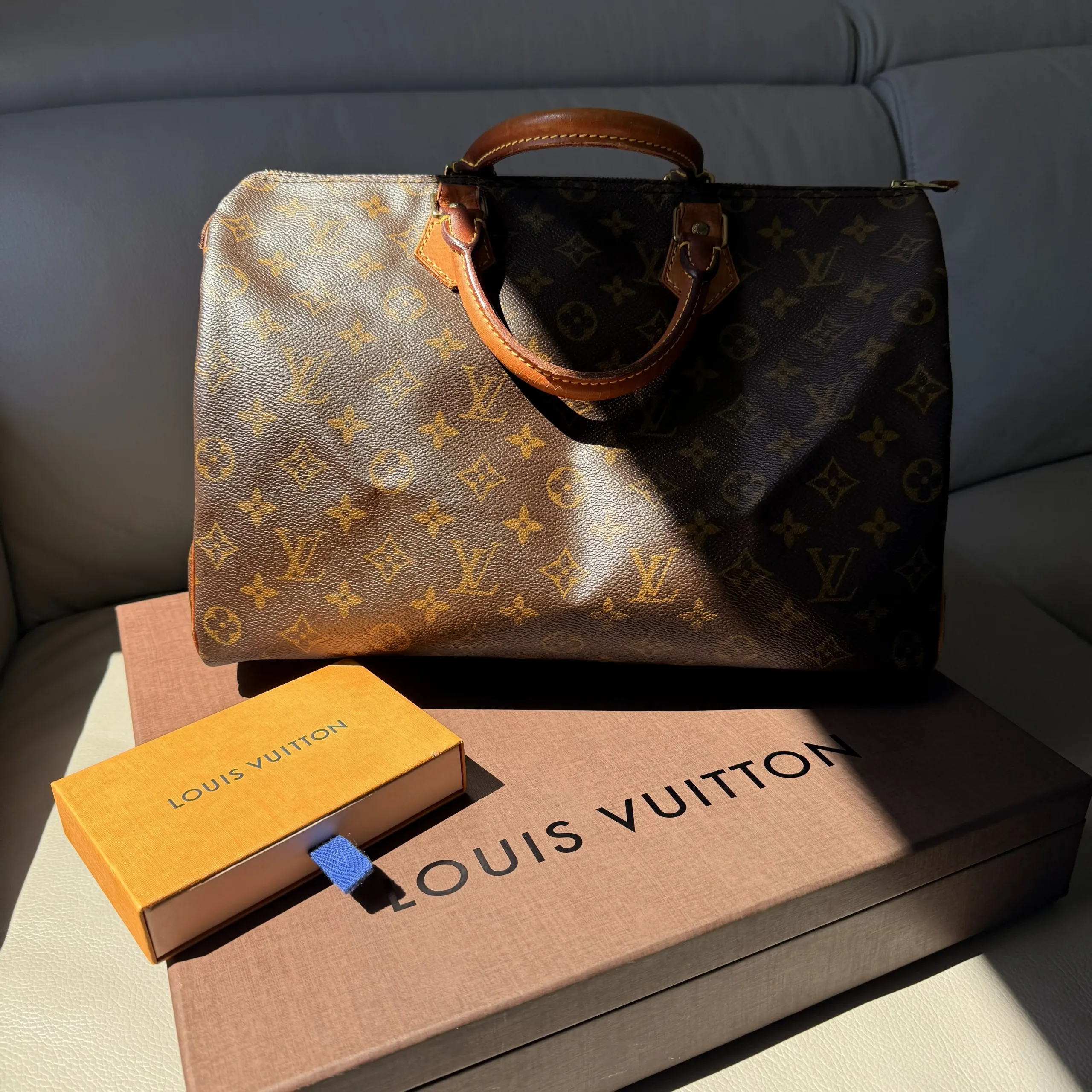
Consider the Speedy, whose origins date to 1930. Compact yet surprisingly spacious, its rounded silhouette and practical top handles reflect the house’s long-standing relationship with travel and movement.
The Neverfull, introduced in 2007, offered a different interpretation of everyday luxury. Lightweight, open and generously proportioned, it became a familiar choice for those seeking a versatile tote.
Then there are the many Monogram crossbody and shoulder bags that have moved in and out of the spotlight over the decades — from structured vintage silhouettes to more relaxed contemporary designs.
Each represents a different expression of the same design philosophy: combining recognisable heritage with practical use.
For the modern wardrobe, this versatility is particularly valuable. A Monogram handbag need not be reserved for a special occasion. It can accompany an ordinary day, an afternoon in the city or a journey abroad.
Luxury, after all, becomes more meaningful when it is part of life rather than simply admired from a distance.
Why Vintage Louis Vuitton Holds A Particular Charm
There is something distinctive about encountering a Louis Vuitton Monogram piece from an earlier era.
A vintage handbag carries more than its original design. It reflects the proportions, construction details and aesthetic preferences of the period in which it was created.
Certain discontinued styles offer a glimpse into chapters of the maison’s history that are no longer represented in current collections. Others remain remarkably similar to their contemporary counterparts, illustrating just how little a successful design sometimes needs to change.
For collectors, these differences can be part of the attraction.
A vintage Monogram bag may feature naturally darkened leather, softened handles or a gentle patina developed through years of use. When consistent with the piece’s age and condition, these characteristics can contribute to its individual character.
Of course, condition matters. Canvas wear, leather integrity, stitching, hardware and overall structure should always be carefully considered when selecting a pre-loved piece.
Age alone does not make a handbag desirable. It is the combination of authenticity, condition, design and personal appeal that gives a vintage piece its place in a considered wardrobe.
At Luxury Revamped, this is part of what makes pre-loved luxury so compelling: the opportunity to discover exceptional designs with a history of their own.
The Monogram And The Art Of Considered Collecting
For someone beginning a luxury collection, the Louis Vuitton Monogram is often among the first signatures considered.
Its widespread recognition and extensive design history make it an accessible starting point for understanding the world of heritage handbags.
Yet considered collecting is not simply about choosing the most recognisable name.
It begins with understanding how a piece will fit into one’s wardrobe and lifestyle.
A Speedy may appeal to someone drawn to classic proportions and the charm of a handheld silhouette. A Monogram crossbody may better suit a wardrobe built around ease and movement. A vintage shoulder bag may offer the individuality that a collector values most.
The right choice is not necessarily the newest, rarest or most expensive.
It is the piece that feels relevant to the person who will carry it.
This is also why pre-loved luxury offers an appealing alternative to buying new. It allows collectors to explore designs from different eras, discover discontinued silhouettes and make selections based on personal style rather than the current season.
While some Louis Vuitton styles retain strong demand in the resale market, values vary considerably according to model, age, condition, authenticity and market trends. A handbag should never be regarded as a guaranteed financial investment.
Its more dependable value is often found in the enjoyment, versatility and longevity it brings to a wardrobe.
A Familiar Signature, A Personal Expression
One of the Monogram’s most enduring qualities is its ability to take on the personality of the person carrying it.
Paired with tailoring, it can introduce warmth and heritage to a polished look. Worn with denim, knitwear and understated footwear, it feels relaxed and familiar. Alongside contemporary silhouettes, a vintage Monogram bag can provide an interesting contrast between past and present.
This adaptability explains why the same design can appeal to collectors with entirely different approaches to style.
For some, the Monogram represents nostalgia — a connection to an earlier generation of luxury fashion.
For others, it represents a first meaningful designer purchase.
And for the seasoned collector, it may be a familiar signature revisited through an unusual silhouette or a carefully preserved vintage discovery.
The pattern remains the same. The story surrounding it continues to evolve.
Why The Monogram Still Matters Today
In a fashion landscape increasingly shaped by rapid cycles of attention, the longevity of the Louis Vuitton Monogram offers an interesting perspective on what makes a design truly enduring.
Its relevance does not depend solely on exclusivity or novelty.
Instead, it comes from a rare combination of history, recognisability, versatility and continued cultural presence.
The Monogram has been reinterpreted by different creative directors, featured in notable artistic collaborations and embraced by successive generations of fashion enthusiasts.
Yet beneath those reinterpretations remains the original signature introduced in 1896.
For those drawn to a more considered approach to luxury, that continuity has particular meaning.
It is a reminder that exceptional design does not always require something new. Sometimes, the most compelling pieces are those that have already demonstrated their ability to remain relevant.
The Luxury Revamped Perspective
At Luxury Revamped, we believe that a beautiful wardrobe is not defined by how frequently it changes, but by the thought behind the pieces chosen for it.
The Louis Vuitton Monogram embodies much of what we appreciate about enduring luxury: heritage, recognisable design, everyday versatility and the possibility of discovering something exceptional from another era.
Whether it is a classic Speedy, a practical everyday tote or a discontinued vintage silhouette, each piece deserves to be considered for its individual character and place within a wardrobe.
Our approach to pre-loved luxury is guided by that belief — selecting pieces not simply because they carry a celebrated name, but because they offer something worth appreciating beyond the season.
Some signatures fade with the season. This one became a language of its own.
Luxury isn’t about owning more. It’s about owning better.