
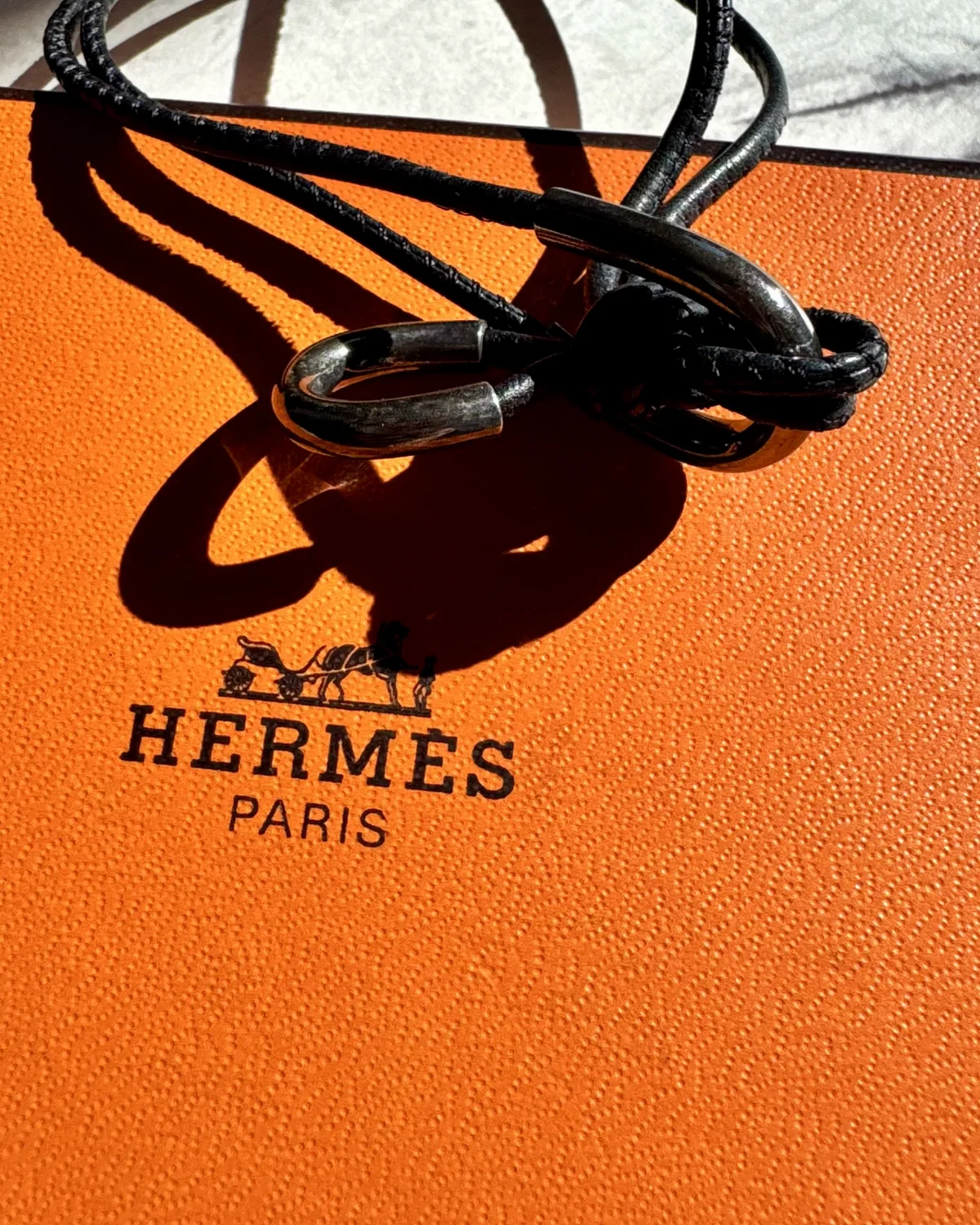
Some houses are recognised by their name. Hermès is recognised by its hands.
Long before a piece carries a name plate, it carries a set of decisions — a stitch, a proportion, a material, a process — that were established generations ago and have barely changed since. These are the codes that make a house a house, rather than simply a label.
The Saddle Stitch
Hermès began in 1837 as a harness workshop, making saddles and bridles for European carriage trade. The stitch developed for that purpose — two needles, one waxed linen thread, pulled through each hole from opposite sides — is still used on its leather goods today.
Unlike a machine’s lockstitch, if one thread breaks, a saddle stitch holds. It was built for a bridle that could not fail mid-ride. That same reliability is why it survived the move from stables to ateliers.
One Artisan, One Bag
Many luxury workshops divide a bag between several pairs of hands — one for cutting, one for stitching, one for hardware. Hermès’ leather ateliers largely still work the other way: a single artisan takes a piece from cut leather to finished bag, often stamping it with their own workshop mark.
It is a slower, more expensive way to build something. It is also why two bags of the same model are never quite identical — each one carries the hand of the person who made it.
An Equestrian Memory
Look closely at Hermès hardware and you find the stable everywhere: the turnlock closures, the strap keepers, the harness-style buckles. Even the house’s most recognised bags trace back to equestrian equipment — a saddle bag reimagined, decade after decade, for a life that moved from horseback to travel.
The codes were never designed as decoration. They were solutions to a practical problem, kept because they still work.
The Orange Box
Even the packaging became a code. Hermès boxes were originally cream — the switch to the now-iconic orange happened almost by accident, during a WWII cardboard shortage when cream stock became unavailable. The replacement stuck, and eventually became as recognisable as anything inside it.
A house’s signature is rarely planned all at once. More often, it is a series of small decisions that were simply never undone.
Why These Codes Endure
This is exactly what we look for when authenticating a heritage piece for Luxury Revamped: not just a logo, but the construction details underneath it — the stitch, the hardware, the proportions — that a house has carried consistently across decades.
A pre-loved piece that carries these codes faithfully isn’t a lesser version of something new. It is proof the codes were built to last this long in the first place.
Leave a Reply